Prabhdeep Gill
Reveal Menu
Market Commentary: Monthly Bulletin March 2026





Key Points
The War in the Middle East Set Global Markets Alight
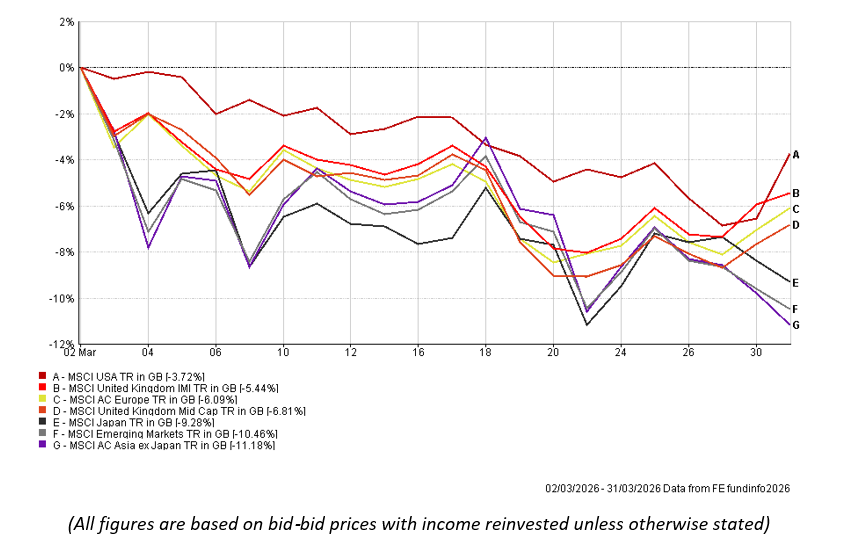
March was a difficult month for investors around the world, with nearly all major stock market falling in value. The trigger was the outbreak of conflict between the United States, Israel, and Iran on 28 February, which quickly escalated into one of the most significant geopolitical events in years. Iran responded by blocking the Strait of Hormuz, a narrow strip of water in the Persian Gulf through which roughly 20% of oil traded globally must pass. The closure sent the price of oil sharply higher, at one point increasing 65% to just below $120 per barrel, before settling back to around $102 as governments around the world released emergency stockpiles to ease the strain.
Higher oil prices push up the cost of almost everything from heating your home to the goods you buy in the shops, and this increased fears that prices more broadly could start rising again after months of progress in bringing them down. Against that backdrop, central banks in the US, UK, and Europe all signalled they were not ready to reduce interest rates as quickly as had previously been hoped. For equity markets, this combination of uncertainty and higher costs was unwelcome leaving investors with few defensive areas to rely on. As the chart above shows, all seven global equity markets ended March in negative territory.
Asian Markets Bore the Brunt
Whilst all regions fell, the sharpest declines were concentrated in Asia. The MSCI Emerging Markets index and the MSCI Asia ex Japan index which focus specifically on markets such as China, South Korea, Taiwan, and India, both fell by 10.5% and 11.2% respectively in March. These are significant drops for a single month and reflect their reliance on oil and gas shipped through the Strait of Hormuz to power their factories and their economies.
South Korea, for example, saw jet fuel prices and shipping costs spike dramatically, threatening the profitability of its major industries including the technology firms that make the computer chips used in phones, laptops, and AI systems worldwide. Despite being a developed economy, Japan was similarly exposed to the energy disruption, with its market falling 9.3% over the month. These falls also erased much of the strong gains that Asian and emerging markets had built up earlier in the year, when they had been among the best performing regions globally.
The UK and US Weather the Storm Better
Compared with Asia, markets in the US and UK were more resilient, though they still delivered negative returns. The US stock market (represented by the MSCI USA index) fell 3.7%, its worst monthly result in several years, but notably shallower than the declines seen elsewhere. The reason the US held up comparatively well is partly that it produces a significant amount of its own oil and gas, meaning it is less dependent on Middle Eastern supplies than many other economies.
The UK equity market fell 5.4% over the month. Larger UK companies, many of which operate globally and include major oil and gas producers were better insulated than medium-sized UK businesses, which fell 6.8%. European shares declined 6.1%. The pattern across all regions tells the same story, the closer a market’s economy is to Middle Eastern energy supplies, and the more dependent it is on them, the harder it was hit.
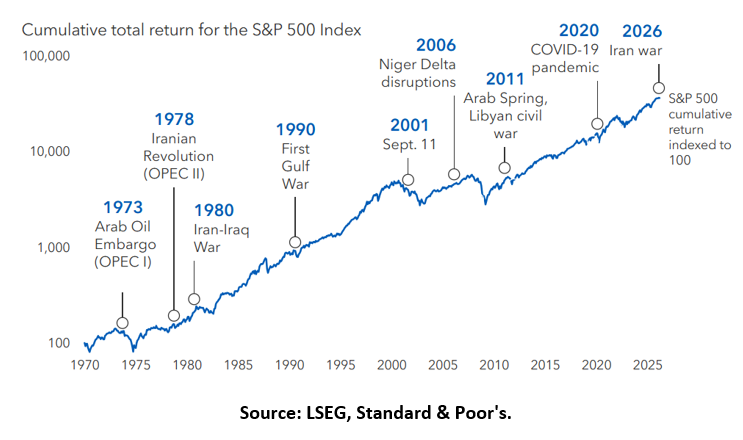
Despite the turbulence of March, it is important to keep some perspective. Markets have historically bounced back after periods of geopolitical uncertainty, often sharply. The chart below shows that in previous oil spikes; markets have powered through previous oil crises. For example, late in the month, early signs of potential peace talks sent share prices jumping on the final trading day for March.
Portfolio Changes
Despite the continued market volatility, the fundamentals underpinning good businesses and their ability to generate profits and grow over time have not changed. We have therefore remained largely invested so that portfolios are well positioned to benefit as markets stabilise over the medium term. That said, we have made a few adjustments within our OEIC funds, where we have the greatest flexibility.
Within our Cautious and Balanced funds, we sold our holdings in the Janus Henderson Strategic Bond and Royal London Short Duration Bond funds. This reflected concerns about recent performance and reduced conviction in the Henderson management team, as well as a desire for greater flexibility than the Royal London strategy offered. Proceeds were reinvested into the Schroder Strategic Bond and PIMCO GIS Income funds.
Ahead of the recent conflict, we held slightly higher cash levels across our OEIC funds (around 6.5–7%), which helped cushion portfolios as equity markets pulled back. Towards the end of March, we reduced cash levels back to 5% to take advantage of more attractive market entry points. Markets continue to react quickly to news—both positively and negatively—and we have seen some significant intraday swings. While the duration of the conflict and associated volatility is uncertain, we remain confident that markets are likely to recover swiftly once there is any positive progress. We are monitoring developments closely and will look to reduce cash again if new opportunities arise.
BOOLERS INVESTMENT COMMITTEE