Prabhdeep Gill
Reveal Menu
Market Commentary: Monthly Bulletin September 2026




Key Points
(All figures are based on bid‑bid prices with income reinvested unless otherwise stated)
A Resilient but Mixed Quarter
The third quarter of 2026 tested investors’ nerves, yet global stock markets came through it in reasonable shape. Rather than moving in a straight line, markets had to climb a ‘wall of worry’, a renewed flare-up in the Middle East, a steep rise in the oil price, and the growing realisation that interest rates were more likely to rise than fall. There were some sharp swings along the way, particularly a difficult July, but a healthy global economy and strong company profits helped shares recover to finish the quarter in modestly positive territory overall.
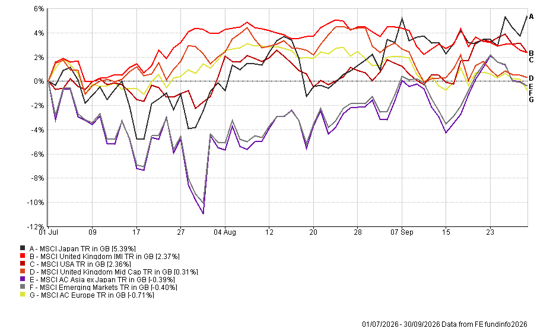
Beneath that calm headline, however, the results varied widely by region. Japan was the clear standout, returning 5.39% over the quarter, while the UK (2.37%) and the US (2.36%) made steady progress. At the other end, Europe (-0.71%), Emerging Markets (-0.40%) and Asia excluding Japan (-0.39%) slipped slightly into the red. With around six percentage points separating the best and worst major markets, and with the leaders changing from one month to the next, it was a quarter that rewarded spreading investments broadly rather than backing any single region.
Oil, Inflation and the Return of Rate Rises
The quarter’s defining theme was the comeback of inflation, and with it the return of interest rate rises. The conflict involving Iran disrupted energy supplies and sent the oil price sharply higher, climbing by roughly 45% at its peak and because energy feeds into the cost of almost everything, this kept inflation stubbornly above target. Central banks responded in the most significant move of the quarter, the US Federal Reserve raised interest rates in September, its first increase since 2023, lifting its key rate to a range of 3.75% to 4.00%, and signalled that a further rise was likely before the year is out.
This marked a decisive shift, having begun 2026 expecting rates to be cut, investors ended the quarter preparing for them to go higher. The main casualty was the bond market, where government bonds fell in value as yields rose to multi-year highs, a reminder that ‘safer’ assets do not always protect against every type of risk.
Earnings and the AI Boom do the Heavy Lifting
If higher rates and oil were the headwinds, strong company profits were the engine that kept markets moving forward. Corporate earnings came in well ahead of expectations across most regions, and the enormous wave of investment in artificial intelligence remained the single most powerful force in markets arguably outweighing both geopolitics and central bank policy.
Demand for the advanced computer chips that power AI was particularly good news for Asia’s technology manufacturers, which staged a strong recovery in August and September after a sharp fall in July. That rebound, however, was not quite enough to erase July’s losses, which is why Asia and Emerging Markets ended the three months marginally lower. Encouragingly, the gains elsewhere began to broaden beyond the handful of giant technology names that had led for so long, with more companies and sectors joining in.
Looking Ahead
The third quarter leaves markets in a more demanding position than a year ago, valuations are higher, interest rates are rising rather than falling, and a great deal of optimism about AI is already reflected in prices. That calls for a degree of caution, but there are genuine positives too, the global economy is growing, companies are delivering real profits, and higher bond yields at least mean that income producing assets are becoming more attractive again.
In keeping with our ‘protect and participate’ approach, we continue to hold well diversified portfolios designed to benefit from these opportunities while cushioning the inevitable bumps along the way. As always, we are monitoring events closely and will adjust positioning as conditions evolve.
BOOLERS INVESTMENT COMMITTEE